
Blog
Returning clients are one of the most valuable assets you can have, just like your team or reputation. It costs 5 to 7 times less to retain them than to attract new ones, and their average check is often much higher. You do not need to convince existing clients of the quality of your services. They already know it firsthand and even help to promote your property by recommending it to their friends and family.
A loyalty program helps you achieve several goals:
- Build a stable base of regular clients
- Boost occupancy during the low season
- Earn more during the high season
- Increase booking lead time and average check
- Increase the number of repeat visits
- Fill gaps in a schedule for less popular services
When a Loyalty Program Does Not Make Sense
1. You are getting a lot of negative feedback from guests and low ratings on review sites. In this case, fix the urgent problems first. Figure out what guests are unhappy about, address these issues, and only then think about introducing a loyalty program.
2. You need a quick and dramatic boost in occupancy. Loyalty programs take time to show results. This is a long-term game.
In this article, you will learn how to develop a loyalty program and implement it at your property.
1. Building Your Guest Database
A database is useful when it contains up-to-date information. This means tracking everything from the moment a guest books their stay, with all the details like room category and extra services. On top of that, guests often come as families, and each family member should have equal access to the benefits of your future loyalty program.
To make this work, you need a PMS where all the information is collected in real time. This will let you segment your guests and identify which ones are the most valuable to your property and which services need more attention. We also recommend adding a CRM system to work with potential guests.
2. Preparation and Calculations
You need to decide what goals your loyalty program will address and what kind of reward system you will offer. Ask yourself what are the main priorities for your property?
- Attracting new guests or keeping existing ones?
- Filling empty treatment rooms?
- Increasing the average check?
- Making my property more valuable in the eyes of my guests?
- Would guests buy more if I gave them discounts?
- What do my guests value most about my service and treatment?
There are several types of loyalty programs. You need to choose based on your property’s needs and capabilities, balancing what works for your finances with what feels like a good reward for your guests.
We recommend combining an accumulation of points with multiple levels and incorporating partnerships. This is a strong trend not just in retail and airlines but hotels as well. For example, the Marriott chain offers a six-level privilege system based on nights stayed. At the lower levels, you get nice little bonuses like late check-out or breakfast. At the top, the rewards are exclusive and valuable.
By choosing a similar approach, you can keep the money and reward your most loyal guests. Below, we will look at what matters when designing such programs.
3. Setting the Terms
Write out the terms and conditions for participants. The key is finding a balance between keeping things simple for a guest and protecting your interests. The first step should be a purchase of a treatment package. Think about what guests need to do within a certain period to keep their current tier or stay in your loyalty program. Here are some options:
- Visit a property at least once every 12 or 24 months
- Spend at least a certain amount
- Book a room in a specific category
- Purchase a specific wellness program, and so on
Decide how many levels your program will have. It is better to start with two or three. Think about what it takes to move up to the next level. The most sensible approach is to tie levels to the total amount spent at your property or the number of nights stayed. For example, Southwest Airlines has three reward tiers. Moving up unlocks new privileges, from priority boarding to a free companion flight.
The rules for earning and spending points should be easy to understand. Choose an exchange rate for how points are awarded. The simplest and best option is one point per local currency unit (USD, EUR, AED) spent. Set an expiration period for unused points, usually 12 to 24 months. Create a table with all the conditions for each level. For example:
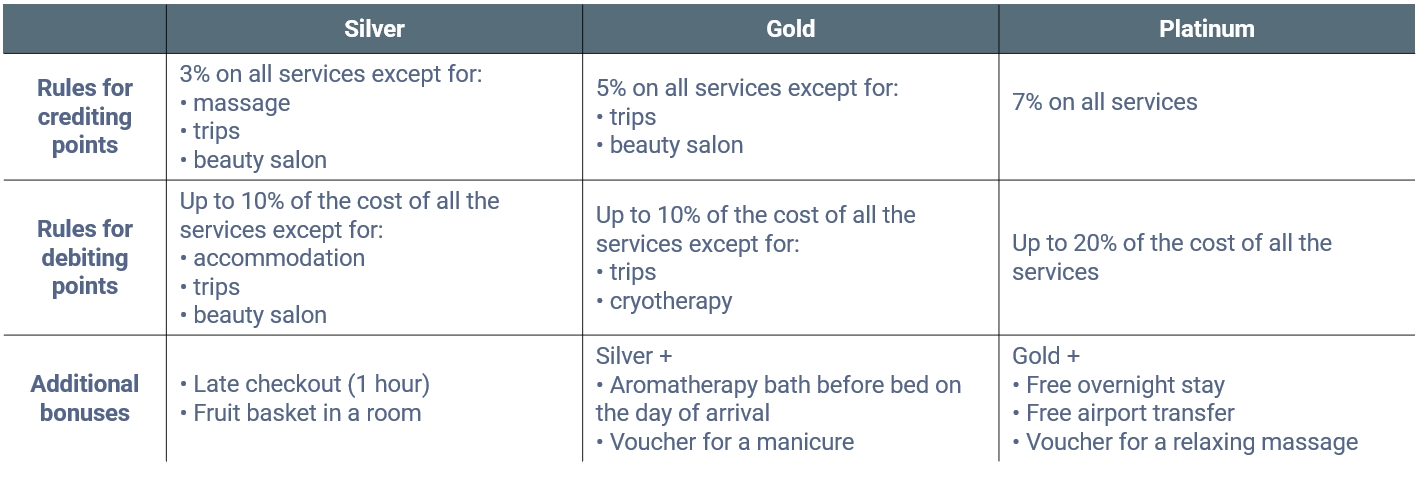
Note that there are different types of points. Tier points determine how many you need to reach the next level, while payment points can be spent on services. In the Silver level from our table above, you can award tier points for massages. It would bring guests closer to the next level, even though they cannot spend these points directly on services.
You can enhance this program with periodic promotions offering special terms for a specific service (new or underperforming). Raise the cashback rate or increase the share payable by points depending on the target audience. For clients with a large point balance, choose the latter. And vice versa.
Do not be shy about turning to your existing guests to attract new ones. A referral program that rewards both parties boosts motivation for everyone involved. For example, guests receive a personal promo link when they check out, which they can share with friends. Anyone who books through that link gets 3% of the cost of their stay credited to their account, and the person who referred them gets 5% from each booking.
Remember that your loyalty program should benefit not just your property but also your guests. Ideally, you want to exceed their expectations so they leave eager to return and recommend your property to others.
4. Handling the Technical Side
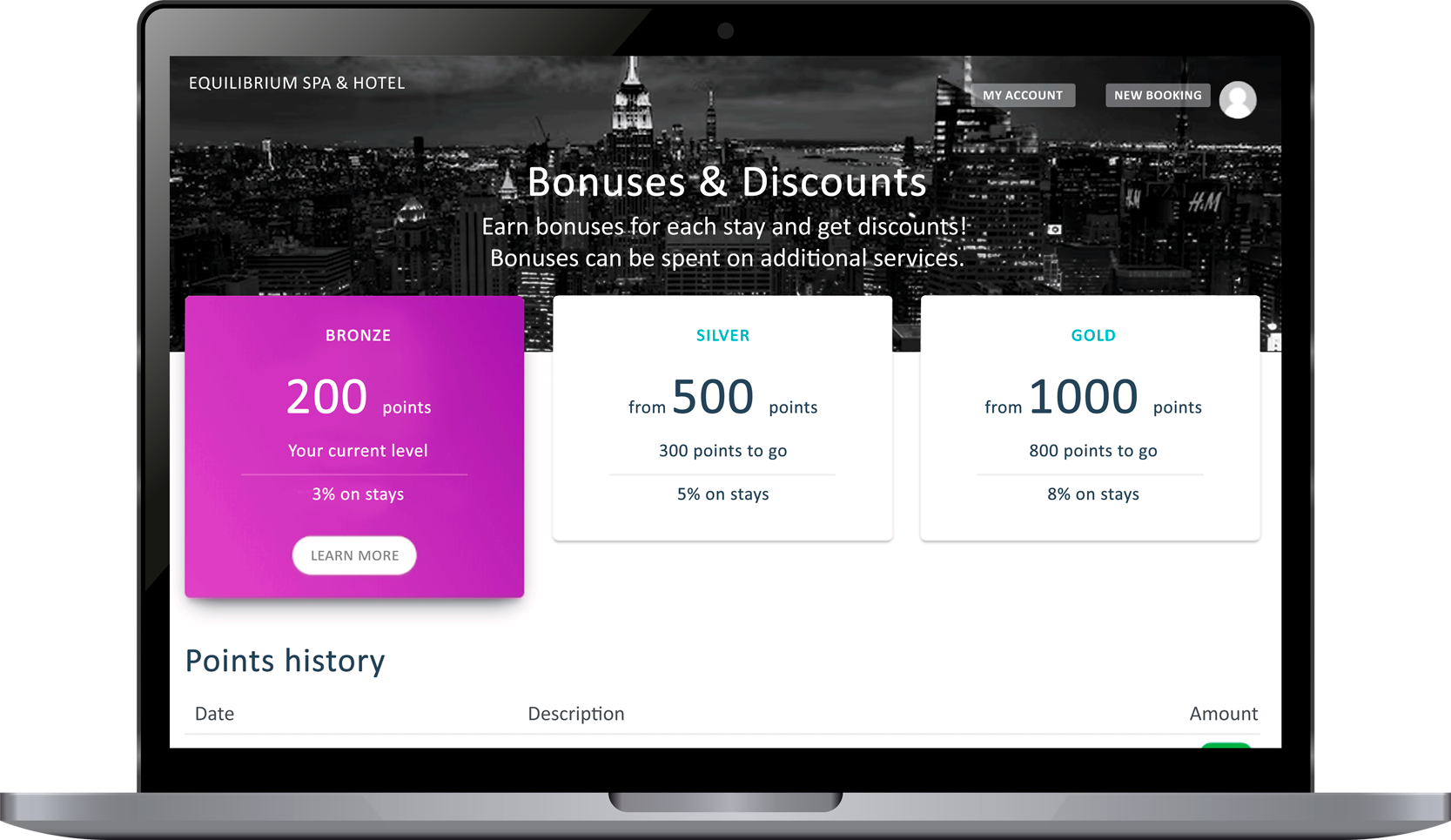
You need the right software to track point accumulation, send data to a guest’s personal account, export updated guest lists for special offers, and handle point payments. You could manage all this manually, but the risk of errors is high, and mistakes that lead to conflicts defeat the whole purpose of a loyalty program. In our PMS, there is a Loyalty module where you can set up the rules for earning and spending points and keep track of all loyalty-related transactions.
How much does it cost to set up an automated loyalty program with points, tiers, and referrals? It depends on several parameters. Fill out a short form to find out. As a bonus, you will get a calculation template «7 customer service indicators».
5. Informing Your Current Guests
Decide how your guests learn about bonuses and offers. There are several common approaches:
- Mobile app for guests. The most effective way to stay in touch. You can send push notifications, show them their available points or discounts, let them browse beauty treatments and book them in just a few clicks.
- Email. You can collect email addresses either on your website or during guest check-in. Use automation services like Sendpulse or Sendsay. Set up an automatic email asking guests to fill out a satisfaction survey in exchange for points.
- Personal account. This is a web resource integrated with your property’s website. In their personal account, guests can see active offers, how many points they have accumulated, or which discount applies to them. You can also let them purchase services directly through their account
Notifications should not be annoying. It is important that after reading your message, a guest immediately understands when and how they can use an offer.
6. Evaluating the Results
To measure how effective your loyalty program is, you need to track a set of metrics. This is usually a multi-factor analysis that considers several indicators, such as:
- Change in room occupancy. It is best not to look at this metric alone because it is influenced by many factors.
- Change in average check. If your loyalty program is successful, your average check should increase.
- Occupancy and profitability of services. This is the simplest way to track promotional activities within a loyalty program.
- Percentage of repeat visits. This shows how often guests come back for a second, third, or tenth time and directly reflects guest loyalty.
- Share of points spent. This tells you how popular are the services that can be bought with points. It is also an excellent measure of how much revenue your loyalty program has saved, because that money would have been lost if you had offered discounts instead.
- Guest satisfaction level. Based on surveys or questionnaires.
- Change in overall profitability. This comes from filling treatment rooms and keeping staff busy. Even when you sell services at a discount, a guest is still covering some or all of the cost.
To get a clear picture, look at these metrics before you launch your loyalty program and then again after some time. Keep in mind seasonal factors, marketing activities, and the broader situation. For each metric, set a growth target that you expect to see after a successful launch.
Compare your numbers year over year to see the results of your work and make adjustments. No one can predict events like a pandemic, but regular analysis will help you respond faster to changes

Remember, a loyalty program for regular guests is not a magic cure. It is just as important that guests are surrounded by friendly staff, that they have a good meal waiting for them in the dining room, and that they see an attentive doctor during their appointments. Even small details influence whether they decide to come back.
To sum it up
A loyalty program addresses many of your goals and can significantly improve occupancy as well as your financial results. The key is to implement it correctly:
- Set measurable goals for your program
- Avoid cash discounts and use an accumulating points system instead
- Define the rules for joining, moving up levels, earning and spending points
- Choose and implement software that handles all loyalty-related tasks automatically and is integrated with your property management system
- Launch your program and inform all the participants
- Evaluate the results
- Adjust the terms, percentages, and services as needed
The Jivi LinkedIn page is a valuable resource for professionals in hospitality and wellness, including executives, managers, marketers, and doctors. We cut through the noise to deliver insights that matter:
- In-depth articles and case studies
- Latest industry trends and news
- Practical tools and smart approaches turned into simple how-to guides
- Ready-to-use checklists and forms to save your time